

The Editor’s Note
Concern over declining literacy rates has reached a fever pitch. Older students who did not fully master foundational reading skills in elementary school are now moving through the system, exposing gaps that are compounding over time.
When middle- and high-school students have weak decoding skills, limited vocabulary, and reduced reading stamina, texts appear increasingly difficult, making it harder for them to read and understand grade-level content across subjects. As a result, their confidence suffers and engagement declines.
Overcoming the challenges facing older readers today—and ensuring these gaps do not become systemic in the future—requires us to rethink how and when we teach basic reading skills such as decoding and phonemic awareness. Simply put: the answer doesn’t begin and end in elementary school.
[Research] A Decoding “Threshold” May Shape More Than Comprehension
Developed in collaboration with the School of Education at the University of North Carolina at Chapel Hill and Doctoral Student and Graduate Research Assistant, Yuzi Gao, PhD in Education (Culture, Curriculum, and Teacher Education)
As schools work to strengthen literacy outcomes, identifying the foundational skills that most strongly shape long-term reading growth is more important than ever. Schools often treat decoding—the ability to recognize and sound out words—as a basic building block. ReadBasix® (formerly RISE) is a foundational reading skills battery used to assess component reading skills including word recognition and decoding (WRD); vocabulary; morphology; sentence processing; reading efficiency; and reading comprehension.
This ETS research memo asks a bigger question: Is there a decoding threshold?—a point below which students may struggle to progress not only with reading comprehension, but with growth across multiple reading-related skills over time.
The study, authored by Zuowei Wang, Tenaha O’Reilly, and Rebecca Sutherland and published as an ETS Research Memorandum (RM-24-06), reports two replication studies using ReadBasix:
- Study 1 tested if there is a specific decoding point where the decoding–comprehension relationship changes and what the impact of the decoding threshold is on other reading skills and development, using 167,403 students in Grades 3–12.
- Study 2 looked at how students above vs. below the threshold behave during decoding items (using response-time patterns), using 14,498 students in Grades 3–12.
Main finding
The authors found strong replication evidence for a decoding threshold at Word Recognition and Decoding (WRD) = 225 in ReadBasix. Because students below this threshold showed lower performance and slower growth across several reading skills, the findings suggest educators can use decoding results as an early signal for broader reading support needs, not just as an isolated foundational skill measure.
Two additional highlights from the memo include:
- Students below the threshold showed slower growth across multiple reading domains. In longitudinal analyses, students below WRD 225 demonstrated lower starting points and significantly slower growth in vocabulary, morphology, sentence processing, basic reading efficiency, and reading comprehension. Taken together, the results suggest that low decoding can act like a barrier: when decoding is too weak, it may slow down how efficiently students build other reading skills over time.
- Response-time patterns offered insight into how students approach decoding. Students above the threshold spent more time on nonwords, consistent with active phonological recoding, while students below the threshold did not show the same pattern. The authors suggest this may reflect fewer opportunities for weaker decoders to engage in the kind of decoding practice that supports later growth.
Practical takeaway for teams using ReadBasix
For teams using ReadBasix, a WRD score of 225 can serve as a useful signal for identifying students who may need more targeted decoding support before reading difficulties compound across domains.
Relevance for the Lexile® Framework for Reading
Although this ETS memo does not analyze Lexile measures directly, ReadBasix can report an official Lexile reading measure based on performance on specific ReadBasix subtests. This means the WRD threshold could be explored as a companion signal alongside Lexile measures when interpreting student reading performance and planning support.
Important limitation
Long-term commercial ReadBasix longitudinal data remain limited, so some growth analyses relied on earlier RISE longitudinal data aligned to the ReadBasix scale. The threshold finding is strongly replicated, but additional longitudinal work in ReadBasix itself would strengthen the evidence base further.
Turn the Page and Press Play: What We’re Reading and Listening To
[Article] Cracking the Code Behind the Nation’s Dismal 8th Grade Reading Scores, The 74, Robert Pondiscio, March 31, 2025
More and more middle- and high-school students are falling below the decoding threshold, which exacerbates the Matthew Effect in reading. So how do we help these students cross the chasm?
[Article] Hiding in Plain Sight: How Complex Decoding Challenges Can Block Comprehension for Older Readers, EdTrust, Rebecca Kockler, Rebecca Sutherland, May 13, 2024
When it comes to poor reading comprehension in older students, are smartphones to blame—or have these students simply reached a decoding threshold?
[Article] When Older Students Can’t Read, AdLit, Louisa Moats
More and more older students are struggling to read. And because reading is difficult, they read even less. How do we help them break this vicious cycle? Spoiler alert: it’s by improving word recognition.
[Podcast] The Hidden Skill Struggling Readers Need but Aren’t Getting with Dr. David Kilpatrick, The Science of Reading Formula, January 26, 2026
Students are struggling to build reading fluency. Learning phonics helps, but without phonemic awareness, it’s not enough. What can we do to turn this trend around?
[Podcast] Helping Students Read Entire Books with Doug Lemov, Colleen Driggs, and Erica Woolway, Melissa and Lori Love Literacy, Episode 239, November 7, 2025
Is reading a book cover-to-cover a lost art—or a powerful antidote to our students’ fractured attention spans?
[Podcast] Not Just Behind—Stuck: Helping Students Cross the Bridge to Skilled Reading, EdView360, May 15, 2025
Older, struggling readers are instructionally stuck—and to break through, they need to do more than just brush-up on their phonics or comprehension strategies. Teachers are yearning for support. But how do we help them?
Did You Know?
70% of 8th graders read below the proficient level
Is it time to rethink our approach to reading and decoding beyond elementary school?
In Case You Missed It
Catch up on the latest expert insights, trusted research, and fresh perspectives from the MetaMetrics Brain Trust.
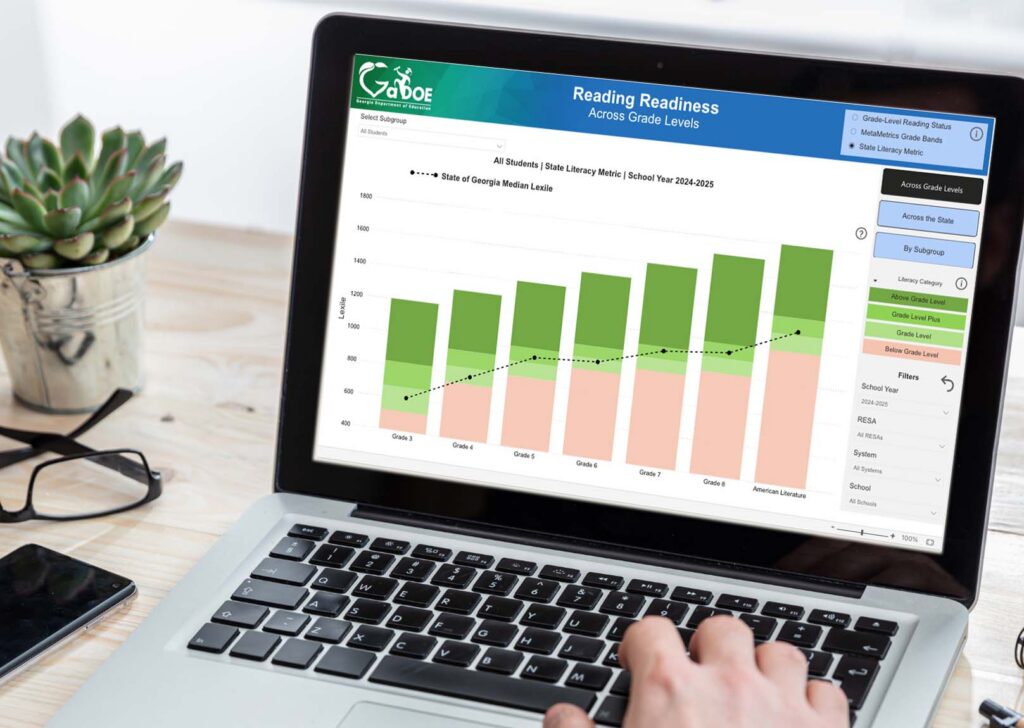
[Article] Improving Literacy Through Actionable Data: The Georgia Reading Readiness Dashboard
[Article] Start Early. Change the Trajectory.
[Press Release] MetaMetrics and North Dakota Department of Public Instruction Partner to Expand Lexile and Quantile Measures for Career Readiness
[Article] Measured Insights, February 2026
Subscribe to Our Newsletter
Stay up-to-date with the latest updates, insights, and announcements from MetaMetrics and our partners.
Sign-up now