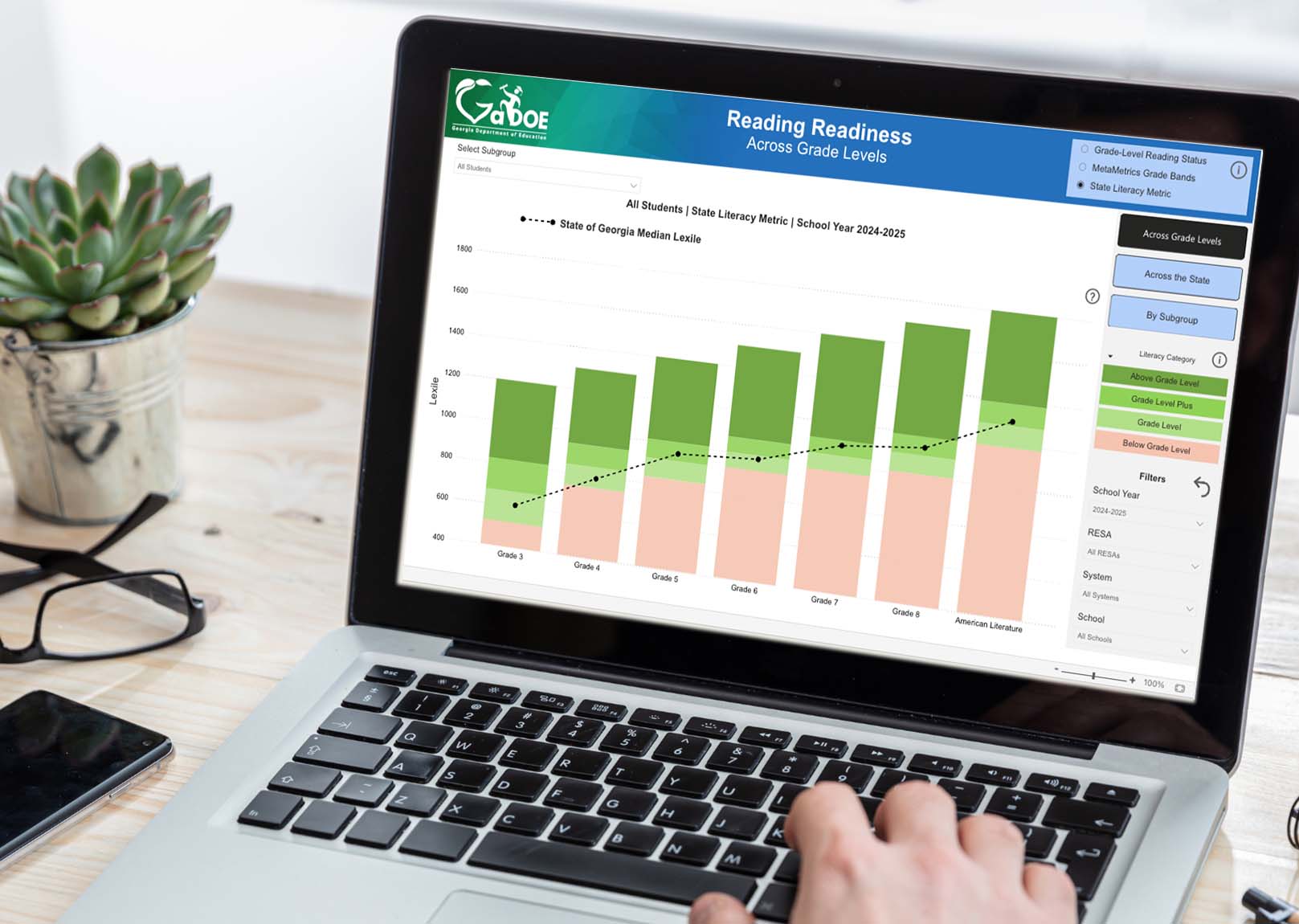

For years, Georgia educators have had access to rich literacy data, but accessing it quickly, interpreting it consistently, and using it meaningfully across classrooms, districts, and communities remained a challenge. As literacy became an increasing focus of state policy, the Georgia Department of Education (GaDOE) recognized the need for a clearer, more usable way to surface reading data and support instructional decision-making statewide.
The result is the Georgia Reading Readiness Dashboard, a publicly accessible, interactive tool designed to bring clarity, transparency, and actionability to K–12 literacy outcomes across Georgia. Incorporating universal measures from the Lexile® Framework for Reading, the dashboard provides a shared, research-based view of student reading readiness and a foundation for improving literacy outcomes at scale.
From Compliance to Clarity
While legislation helped accelerate the work, the motivation behind the Reading Readiness Dashboard went far beyond compliance. Georgia leaders saw an opportunity to improve how literacy data served educators, districts, and communities.
Districts already had access to data, but it was often fragmented. We were trying to think about how to make that information more usable, more accessible, and more meaningful—not just data for the sake of data, but data that could actually inform instruction and support students.
— Dr. April Aldridge, Deputy Superintendent of Teaching & Learning, GaDOE
Before the dashboard, literacy information was often spread across multiple reports and systems, placing an analytic burden on districts and schools. Leaders and educators spent time reconciling numbers rather than focusing on instructional planning and student support.
The dashboard was designed to change that by providing a centralized, intuitive view of reading outcomes that supports transparency, reduces workload, and enables faster, more informed conversations grounded in consistent, defensible measures.
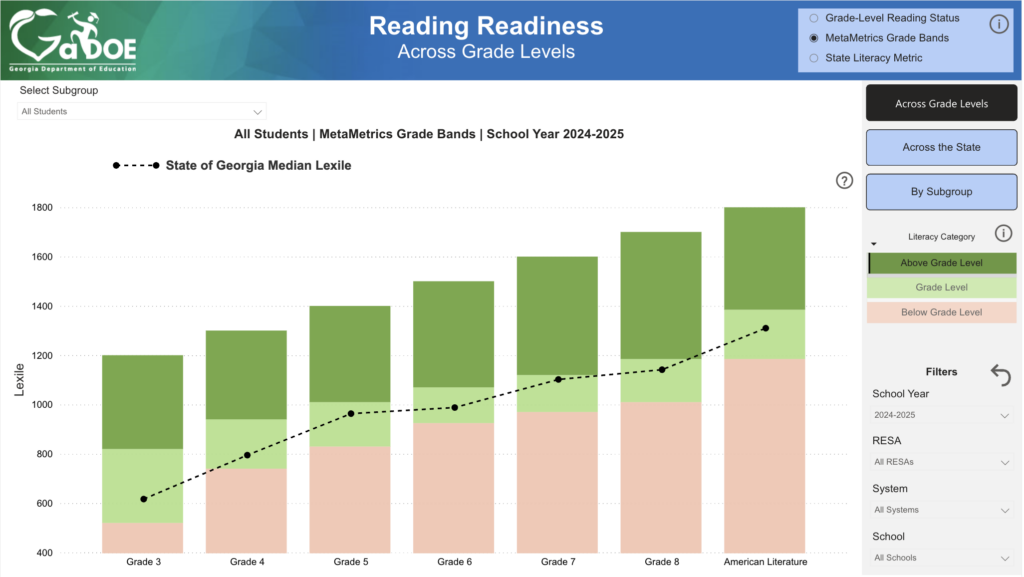
The GaDOE Reading Readiness Dashboard allows users to view by MetaMetrics grade bands, powered by the Lexile Framework for Reading.
Defining Reading Readiness for Georgia
A key design decision was how to define and communicate reading readiness in a way that would resonate with a broad public audience and support statewide alignment. Following the passage of the Georgia Early Literacy Act (HB 538), the State Board of Education, GaDOE, and the Governor’s Office of Student Achievement worked collaboratively to establish a common, statewide literacy metric beginning in grade 3.
Rather than relying on a single, binary indicator, GaDOE introduced a more nuanced state literacy metric powered by the Lexile Framework for Reading, allowing student performance to be viewed across multiple readiness levels. This approach reflects an understanding that literacy development is a continuum and that instructional decisions are strongest when educators can see patterns of progress, not just pass/fail thresholds.
The Reading Readiness Dashboard was designed to support a shared vision for literacy across Georgia—one grounded in clarity, coherence, and continuous improvement.
— Amy Denty, Director of Literacy, Office of Teaching and Learning, GaDOE
Built from Georgia Milestones English Language Arts assessment data, the dashboard translates this statewide metric into accessible Lexile bands that describe where students are along the reading continuum. Unlike overall ELA proficiency—which reflects a broader set of skills, including writing—the Reading Readiness metric focuses specifically on grade-level reading proficiency. This distinction allows educators and leaders to more precisely examine students’ readiness to access complex texts and content across disciplines.
Creating something centralized gave us a much clearer way to see the full picture of student literacy progression.
— Allison Timberlake, Deputy Superintendent for Assessment and Accountability, GaDOE
The dashboard presents results at the state, district, school, and RESA levels, with filters for grade level and student subgroups including race/ethnicity, English Learners, students with disabilities, and migrant students. This structure supports both statewide accountability and local instructional planning, allowing educators to explore data in ways that align with their context.
Why Lexile Measures Matter
To anchor the dashboard in a trusted, instructionally meaningful framework, GaDOE relied on Lexile-based Reading Status reporting derived from the Georgia Milestones English Language Arts assessment.
The Lexile framework has long been used in Georgia and is aligned to the science of reading, supported by decades of research. This makes Lexile measures a familiar and credible choice for educators and leaders. Just as importantly, Lexile measures connect assessment results directly to instructional planning, resource selection, and student growth pathways.
We’ve used Lexiles and those ranges for much longer than I’ve been at the department. That’s always been our reading measure. We love them and use them because of all of the research behind them. It would be foolish of us to try to come up with our own measure of grade-level reading when Lexile measures already exist. We can provide the Lexile measures on our assessment, and districts can get measures reporting through interim and other assessments and products they’re already using.
— Jan Blose, Director of Assessment Development, GaDOE
From MetaMetrics’ perspective, the dashboard illustrates how assessment data can move beyond reporting toward real instructional impact.
Lexile measures are designed to connect assessment performance to real instructional decisions. When states use them in tools like the Reading Readiness Dashboard, data becomes not just transparent, but instructionally useful.
— Julie Worden, Sr. Director, State Partnerships, MetaMetrics
Lexile measures used in the dashboard are based on student performance on a subset of ELA assessment items, translating test results into an interpretable scale that reflects reading ability. This ensures the dashboard balances technical rigor with clarity and accessibility for a broad public audience.
Building With Responsibility and Purpose
Because the dashboard is public-facing, GaDOE placed strong emphasis on responsible data use. Clear calculations, consistent business rules, and accessible explanations were built into the design to support accurate interpretation and avoid misuse.
We’re trying to do all of these calculations in advance so that districts are not all having to do this thinking, and schools and parents or other stakeholders are not having to do this thinking. It’s gratifying to know that’s not being done 200-plus times across the state by other users.
— Elena Nightingale, Program Manager, Psychometrics and Reporting, GaDOE
Collaboration with MetaMetrics focused on validation, interpretive guidance, and ensuring readiness categories aligned appropriately with Georgia’s assessment design. By establishing guardrails at the state level, GaDOE reduced the analytic burden on districts and promoted consistency, credibility, and trust across the system.
The dashboard is intended to be used alongside screeners, classroom assessments, and local data sources, reinforcing the idea that high-quality measurement works best as part of a broader instructional ecosystem.
Impact: Better Conversations, Clearer Focus
Since launch, the Reading Readiness Dashboard has begun shaping literacy conversations across Georgia. District and school leaders are using it to identify trends, target support, and engage in more consistent, evidence-based discussions about reading outcomes.
It reduces the load of districts crunching numbers and provides them with a tool that helps them be more efficient. They can spend less time crunching numbers and more time thinking about instructional strategies, instructional planning, interventions, and other things to impact teaching.
— Allison Timberlake, GaDOE
The dashboard is updated annually using summative assessment data and lives within Georgia Insights, part of the broader Georgia Connects ecosystem. Professional learning offered by GaDOE’s Teaching and Learning team further supports districts in using the tool to its full potential.
Looking Ahead
As Georgia continues strengthening its literacy strategy, the Reading Readiness Dashboard serves as a durable foundation for sustained improvement, supporting educators, informing communities, and reinforcing statewide alignment around reading outcomes.
State leaders view the dashboard as a long-term resource that can evolve alongside instructional priorities, policy goals, and emerging opportunities to expand transparent, research-based reporting into additional content areas.
At its core, the Reading Readiness Dashboard aspires to be a tool for shared understanding and collective responsibility. By making reading data transparent and comparable across contexts, it supports meaningful conversations about progress, challenges, and next steps—helping Georgia move toward a future where every student is equipped with the reading skills needed to thrive in school and beyond.
— Amy Denty, Director of Literacy, Office of Teaching and Learning, GaDOE
To learn more about how we partner with state education agencies, please visit our Who We Serve: Policymakers page. Please reach out if you’d like to discuss how our reading and math frameworks can support learning for your districts and schools.
Subscribe to Our Newsletter
Stay up-to-date with the latest updates, insights, and announcements from MetaMetrics and our partners.
Sign-up now