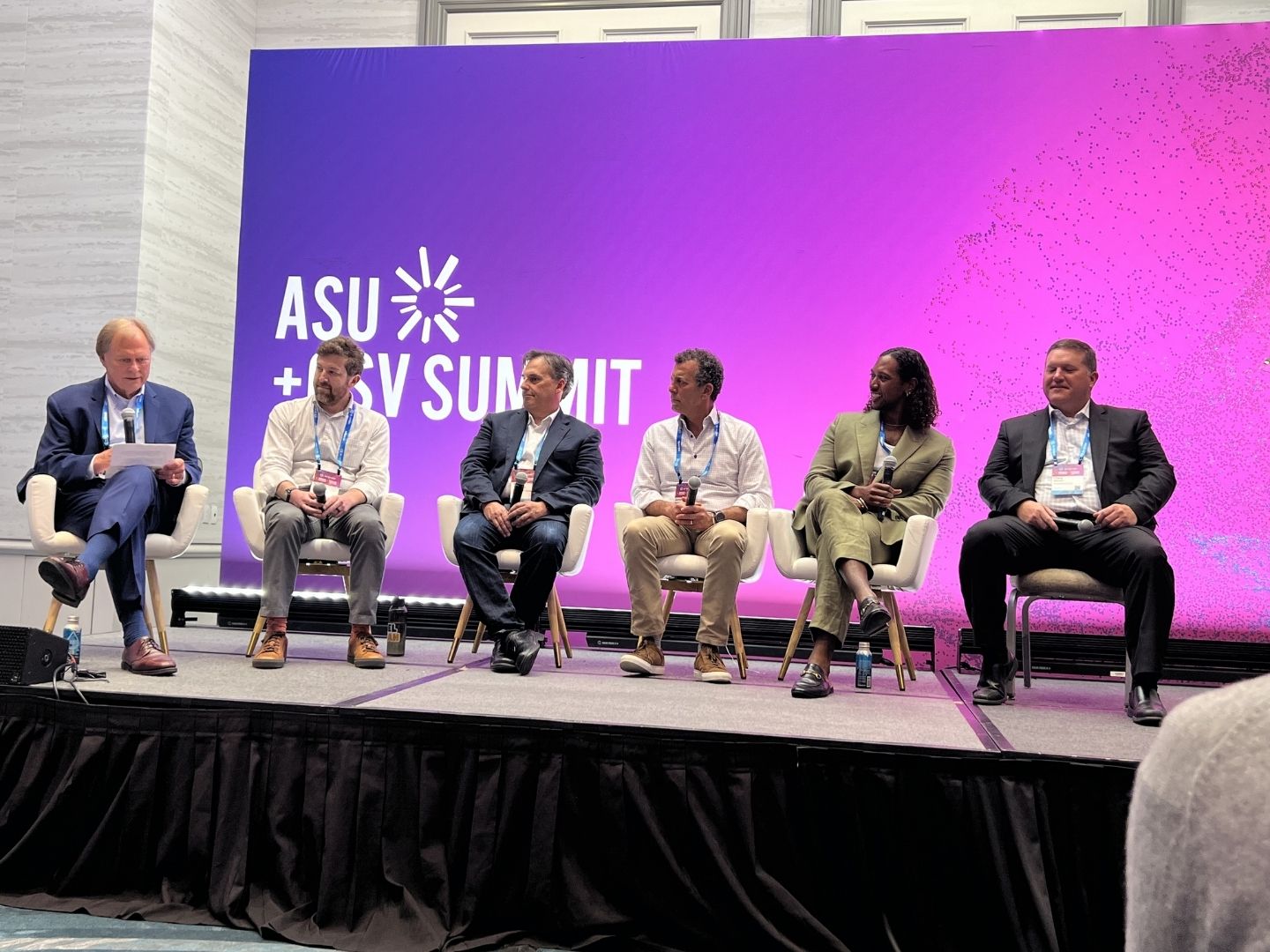


Over 7,000 educational leaders, policymakers, and educators recently came together in San Diego for the ASU+GSV Summit 2026, a place where critical conversations about innovation, technology, and thought leadership take the stage. It was MetaMetrics’ fourth year sponsoring the event, and we had a strong showing this year, with 14 team members engaging in over 80 meetings with education leaders and partners.
Speakers at this year’s ASU+GSV Summit, including leaders from MetaMetrics, explored important topics that are top-of-mind for innovative, educational leaders nationwide. From forward-looking strategy to real-world execution, these prime stage sessions and panel discussions brought together policy, research, and advocacy. And while it’s impossible to capture the energy and excitement that echoed through the halls of the event, below, we’re sharing a few key takeaways.
5 Key Takeaways from ASU+GSV Summit 2026
From digital learning to workforce readiness, ASU+GSV Summit sessions cover many diverse topics. Here are four key takeaways we observed.
1. Shared, comparable measures are essential—but not yet universal
School choice is a topic that is gaining momentum across the country. With all states offering some form of school choice, ranging from public-only options and private school choice to public, charter, and magnet alternatives, it’s no wonder it made the agenda at the ASU+GSV Summit.
MetaMetrics’ CEO, Chris Minnich, participated on a panel for the session entitled “Laying the Tracks—The Modern Infrastructure Powering Multiple Choice.” In this session, he and his fellow panelists addressed a number of challenges and opportunities related to school choice, including one of the biggest challenges: How can we determine that students are truly better off?
Chris offered a potential solution: A universal or common measure that gauges students’ reading and math ability, difficulty of learning materials, and growth, and places them on the same scale, without the need for additional testing. Chris advocated that with these measures, educators and administrators can better pinpoint where students are today. And with this starting point in hand, they can better predict, forecast, and plan for what’s next in their learning journey.
“One of the things I would encourage states to look at is if we are really going to be accountable for these [public] dollars going out, we have to have a system of measurement that maybe includes some assessments, but also includes long-term outcomes for students. Whether or not they move on to college, whether or not they are successful in life.”
Chris Minnich, CEO, MetaMetrics
Consistent, universal measures—like the Lexile® and Quantile® Frameworks—not only provide a consistent way to measure student ability and progress, but they also bring clarity and transparency to expectations, which makes it possible to compare results across schools.
While the debate over school choice continues, this session provided excellent insight for states to consider as they evolve and expand their own school choice programs and for assessment providers to take into account as they are called upon to meet the need for actionable student data.
Check out additional highlights from Chris’ session.
2. Learning must evolve for the AI era
Education is evolving in the age of AI, raising new questions about how it must evolve to support students in this AI-driven era. And while obtaining new skills such as how to use AI responsibly and ethically may be obvious, other, softer skills are emerging as equally as important—if not even more.
Kaya Henderson, Executive Vice President at the Aspen Institute, shared the following three skills as ones becoming increasingly critical in the age of AI:
- Critical thinking: Students today need to know how to problem solve, to struggle, to build resilience, and ultimately find a conclusion.
- Discernment: At a time when it’s difficult to know what’s real and what’s fake, it’s important for students to know how to tell the difference.
- Human skills: As AI becomes more integrated into our everyday lives, building interpersonal skills such as empathy, civil discourse, and collaboration, just to name a few.
Rick Hess, Senior Fellow at the American Enterprise Institute, believes that a core foundation in academics remains imperative. Literacy, numeracy, history, and other core academic subjects are the basic building blocks that help students understand and make sense of the world around them. And while he agrees that human skills such as creativity, communication, critical thinking, and so on are foundational to human endeavor, he asserts that they are best learned in the context of academics, where there is heavy cognitive load, such as delving into great works of literature or working together on a STEM project.
Further, tools like AI hold the potential to change the game when it comes to education. For example, a teacher can use AI to help them create a lesson plan that is not only engaging but reflects the interests of the students in their classroom. And while this is game-changing, it’s a support. It’s not the destination; it simply helps us on a journey.
Listen to more insights in the session “What Do Kids Need to Learn in the Age of AI?”
3. Closing the education/workforce gap is crucial
Another compelling topic focused on the connections—or lack thereof—between education and the workforce. In the standing-room-only session, “From Silos to Systems: How States Are Reuniting Education and Workforce,” panelists explored the urgent need to connect the skills students are learning today with the ones needed to succeed in the workforce, today and well into the future.
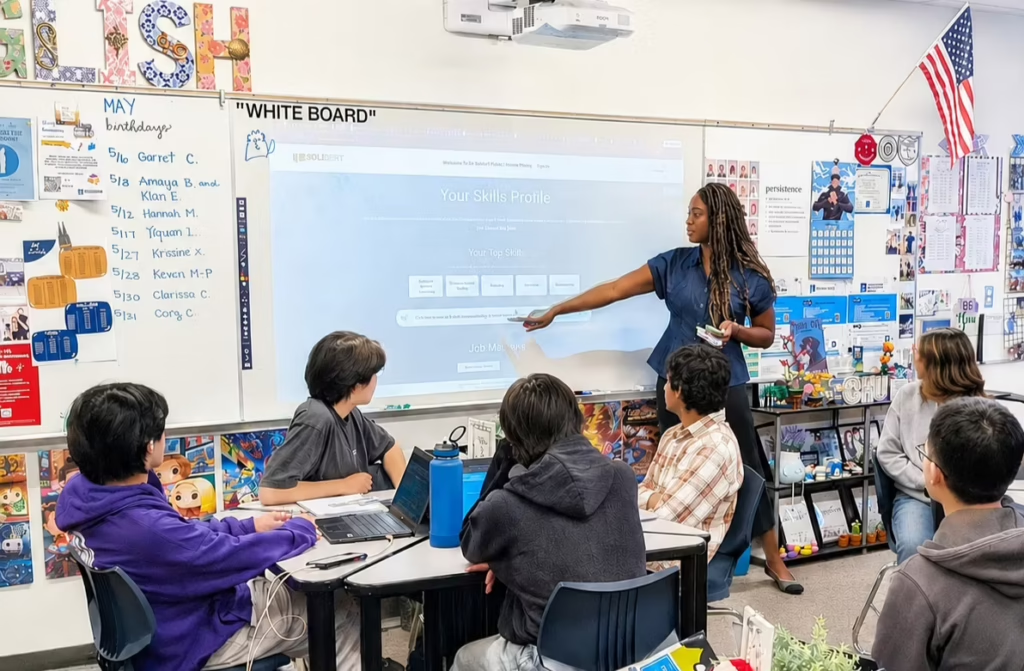
Nadja Young, Chief Brand Officer at MetaMetrics, joined the panel, sharing compelling scenarios related to student reading and math ability, projected growth of these skills, and readiness for top-growing careers in Ohio and Alabama.
The first scenario relates to the state of Ohio. A junior in high school has a Lexile measure of 1300L, which tells us she’s ready for college. Using MetaMetrics’ corpus of measured texts, we know that this score also indicates that she can read and understand an IRS tax notice and a credit card agreement. Surprisingly, however, a Lexile measure of 1300L will make it difficult for her to understand a lease agreement or a privacy notice from Airbnb. Her 1300L measure also means she’s currently qualified for five out of the top 10 fastest growing careers in Ohio. She could become a nurse practitioner, but if she aspires to be a physician’s assistant, she’ll need to do some work to increase her Lexile score.
In Alabama, Nadja shared that an eighth-grade student has a Quantile measure of 800Q. With this ability, he can calculate tax and a tip at a restaurant or apply a coupon effectively in a retail establishment. If the student continues progressing at the same pace, he can expect to have a Quantile measure of 1080Q upon graduating from high school. Again, this would qualify him for five of the top 10 fastest growing careers, such as cook, nurse practitioner, or information security analyst, but not statistician or electric mechanical technologist.
When students know which careers will likely have openings, the salary ranges for these roles, and the education level required, they become empowered to make informed decisions about which paths they want to pursue. And when these students have Lexile and Quantile measures available early in their educational journeys, they enable educators to support students in achieving their goals.
In the case of our student in Alabama, if he aspired to be a statistician, his teachers and parents could provide him with the extra support needed to improve his Quantile measure so that by the time he graduated high school, he was better prepared for college and for the career he wanted to pursue.
“By getting this precise, kids can start thinking about the fields they want to be in and know that there’s a whole constellation of careers available or jobs available within a field, and they can start to get serious about their planning so they can succeed.”
Nadja Young, Chief Brand Officer, MetaMetrics
Watch the full session to hear more about how states are bridging the gap between education and workforce readiness.
4. Career-connected learning is non-negotiable
Continuing on the topic of workforce readiness, MetaMetrics’ Vice President for Government Relations and former Secretary of Education in South Dakota, Melody Schopp, moderated a discussion on what it really takes to build career pathways for students.
This lively discussion featured panelists Amanda Peterson, Assistant Superintendent at the North Dakota Department of Public Instruction; Andy Rotherman, Co-founder and Senior Partner at Bellwether; and Seth Gerson, Education Program Director, National Governors Association (NGA) Center for Best Practices. Throughout their discussion, three key points came to light:
- Successful, career-connected learning must integrate K-12, higher education, and employers in a connected system where pathways are designed to be cohesive, not fragmented.
- Success depends upon having shared, universal measures that can answer questions such as “What does ‘proficiency’ actually mean?” and “Are students prepared for in-demand careers?”
- We need clearer transitions from classroom to career that go beyond graduation, enabling students to follow viable, well-aligned post-secondary pathways to college, career, and life.
Watch the full discussion of the session “Bright and Early: Building Pathways from Classroom to Career.”
5. Scaling Solutions Based on Data is Critical
While it is impossible for us to touch upon every topic discussed during the event, there is one more theme that is gaining steam and worth mentioning. State departments of education and districts are thinking about learning at scale, powered by data. In the session, “Turning Goals Into Scalable Systems: Statewide Career Navigation in Action,” state leaders shared strategies and examples of the ways in which they are putting policy into practice using aligned data strategies, open career navigation platforms, and K–12, postsecondary, and workforce system coordination.
Key takeaways from this conversation include:
- Everyone—from state policymakers to EdTech vendors to district leaders—must be aligned in their mission to help students.
- Building buy-in at the state level is critical to success.
- Selecting the right technology helps states and districts use their data better.
- Career-connected learning must be evident in every aspect of the academic journey.
- Foster “partnership not compliance”—technolgy doesn’t work without people buying in to it.
In addition, F. Mike Mills, Superintendent of Public Instruction of the Houston Independent School District, shared his strategies for responding to learning declines and improving accountability using evidence-based action in the session, “From Evidence to Action: Dealing with Learning Declines at Scale.”
Some words of advice:
- Don’t be afraid to make bold changes.
- Pay teachers for effectiveness, not years of experience.
- Don’t be afraid of accountability, but…
- Accountability isn’t real without a consequence. Make sure you have the right support in place.
- Make learning durable skills like information literacy, problem solving and decision making, and critical thinking mandatory.
- Establish clear metrics to gauge effectiveness of activities and objectives.
Inspiring a Brighter Tomorrow
Clearly, literacy, numeracy, and career-connected learning are top-of-mind for educational leaders and edtech providers alike. And as evidenced through our discussions, the growing need for common, universal measures is becoming more urgent every day. Without them, it will remain difficult to understand student progress and how their ability today impacts the skills needed for tomorrow. But with these measures in place, everyone will have the insight they need to connect learning today with the skills needed for tomorrow.
Subscribe to Our Newsletter
Stay up-to-date with the latest updates, insights, and announcements from MetaMetrics and our partners.
Sign-up now