

Many school districts and state education agencies across the United States require Lexile® measures for their reading materials. But translate that requirement into Spanish, and things quickly get more complicated. A word-for-word Spanish translation of an English book doesn’t carry the same Lexile score as the original because elements such as sentence structure, word frequency, and rhythm of the language shift the measure entirely.
As states expand support for Spanish-speaking students, demand for Spanish Lexile measures is growing. Texas reports Spanish Lexile measures from its statewide assessment, and California requires a link between its Spanish-language assessment and the Spanish Lexile scale. In both cases, the goal is to help connect students with appropriately challenging Spanish-language materials. But what is the value of measuring Spanish content—and how do English and Spanish Lexile measures work together?
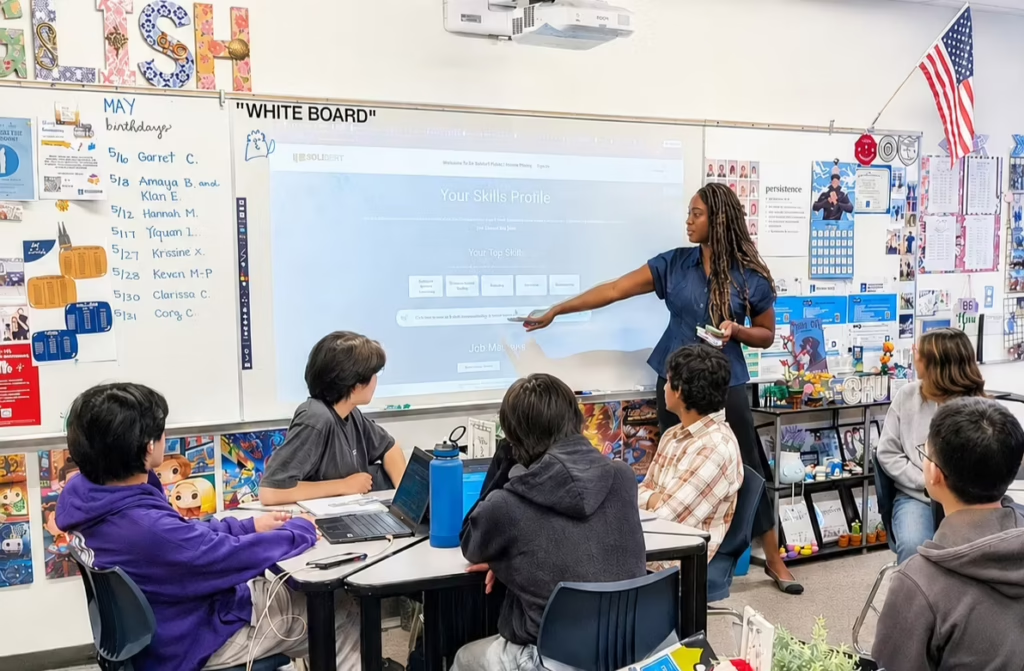
To gain an educator’s perspective on the topic, we asked Efraín Tovar, M.A.Ed., to weigh in. Efraín is a veteran educator, certified bilingual teacher, founder of the California Newcomer Network (CANN), and a MetaMetrics Educator Ambassador. He holds a California Bilingual, Crosscultural, Language and Academic Development (BCLAD) authorization and is a graduate of Fresno Pacific University. Efraín currently teaches middle school at Abraham Lincoln Middle School in Selma, California, where he works closely with newcomer and multilingual students. His work focuses on bilingual education, asset-based instruction, and creating equitable learning opportunities that honor students’ language, culture, and lived experiences.
Reading Across Languages: Why Spanish Lexile Measures Matter
Preface by Efraín Tovar
For educators serving bilingual and multilingual learners, access to quality Spanish-language texts is about much more than translation. It’s about recognizing that students walk into our classrooms already carrying linguistic knowledge, cultural experience, and literacy assets.
In my work with multilingual learners—particularly newcomer students—I’ve seen what happens when we stop treating a student’s home language as something to leave at the door and start treating it as something to build on. Spanish Lexile measures can help us do exactly that.
MetaMetrics: What’s the value of having Lexile measures for Spanish content?
Efraín: Lexile measures for Spanish content give educators another tool for making intentional instructional decisions. Instead of asking, “Is this book appropriate for a seventh grader?” we can ask a more useful question: “Is this Spanish text appropriately challenging for this reader?”
That distinction matters more than it might seem. Students in the same classroom can have wildly different literacy histories. One newcomer may have attended school continuously in their home country and read fluently at grade level in academic Spanish—what we’d call a SAFE newcomer, a student with adequate formal education. Another student the same age may have had their schooling interrupted, landing them in the SLIFE category: students with limited or interrupted formal education. A heritage Spanish speaker might talk easily with grandparents at the dinner table but have had almost no chance to develop academic reading or writing in the language. None of those students should get handed the same text just because they’re the same age or speak the same language.
The Spanish Lexile Framework lets us look at Spanish reading ability and Spanish text complexity together, so we can hand a student something accessible enough to build confidence but still challenging enough to grow. A Lexile score should be a tool, not a label—it should inform a decision, not define a kid.
MetaMetrics: How should English and Spanish Lexile measures work together?
Efraín: English and Spanish Lexile measures are two pieces of the same story, not interchangeable numbers. MetaMetrics is explicit that the English and Spanish frameworks are independent, and that Spanish Lexile measures should be used to match students with Spanish texts. So I’d push back on statements like “the student is 700L in Spanish, so they must be around 700L in English.” That’s not how it works.
Instead, look at both measures side by side and ask what they tell you about the learner. If a student reads well in Spanish but is still building English literacy, that Spanish ability is an asset, not a footnote. It likely means the student already understands text structure, inference, argument, main idea, vocabulary relationships—comprehension strategies in general—even if they can’t yet show all of that in English. Research on bilingual literacy backs this up: skills genuinely transfer between the two languages.
So instead of asking what a student lacks in English, ask what they already know and how you can build from there. It’s a small shift in framing, but it changes how you teach.
MetaMetrics: Does the Science of Reading apply to Spanish?
Efraín: Yes, it does, with a real caveat. The foundational pieces such as phonological awareness, decoding, fluency, vocabulary, oral language, and comprehension are absolutely relevant to Spanish literacy, and research with Spanish-speaking learners backs up the importance of explicit instruction in these areas.
But the Science of Reading applied to Spanish can’t just mean an English reading program run in Spanish. English is full of spelling traps. For example, “-ough” alone shifts sound in though, tough, through, and cough, while Spanish letters map to sounds far more predictably. That difference has to shape instruction: teach Spanish through its own phonology, syllable structure, morphology, and syntax, not rules borrowed from English.
The goal isn’t an English program delivered in Spanish—it’s Spanish literacy instruction built around how Spanish actually works. And for bilingual learners, we should be intentional about helping them notice what transfers between languages and what doesn’t. That’s how metalinguistic awareness develops, and it’s one of the real advantages of growing up bilingual.
MetaMetrics: What should publishers think about when developing Spanish-language content?
Efraín: Don’t treat Spanish content as a translated version of English content—that’s the first thing to get right. Good Spanish materials need to be linguistically authentic, instructionally purposeful, culturally meaningful, and age-appropriate, which means paying attention not just to vocabulary and complexity, but to natural Spanish syntax, morphology, background knowledge, and the specific skills a text is meant to build.
Cultural authenticity matters just as much. There’s no single “Latino experience,” any more than there’s one way of speaking Spanish. Our students and families come from Mexico, Central America, South America, the Caribbean, Spain, Indigenous communities, immigrant communities, and U.S.-born heritage-speaking households, representing countless regional and cultural identities. Content should reflect that range instead of flattening it into a handful of celebrations, foods, or historical figures.
I’d especially encourage publishers to bring Spanish-speaking educators, bilingual literacy experts, families, authors, and students into the process from the start, not just at the translation stage. And don’t forget older multilingual learners. A middle or high schooler who’s still building foundational literacy doesn’t need a book written for a six-year-old just because the reading level fits. Our students deserve materials that are both accessible and age-respectful. That’s a real opportunity publishers are still missing.
Final thoughts from Efraín: Measuring more than reading
At the end of the day, Lexile measures—English or Spanish—are most useful when they help us see learners more clearly. A number can tell you something about how a reader relates to a text. It can’t tell you the student’s story. It can’t measure resilience, background knowledge, bilingualism, culture, curiosity, or what a newcomer carries into the classroom every day.
That’s on us to find out.
Get that right—good measurement, strong pedagogy, materials that reflect who our students actually are—and you’re not just teaching a second language. You’re helping a kid see that everything they walked in already knowing, including the language they already speak, counts.
Bring the Lexile Framework to Your Spanish Materials
High-quality Spanish materials deserve measures developed specifically for the language in which they are written. If you’re a publisher or content developer interested in obtaining Spanish Lexile measures for your materials, email hello@metametrics.com to learn more.
Subscribe to Our Newsletter
Stay up-to-date with the latest updates, insights, and announcements from MetaMetrics and our partners.
Sign-up now